Cyberattacks: nearly tripled in five years, and 2026 is speeding up
In five years, an organisation went to nearly three times as many attacks per week (Check Point). Ransomware victims rose by half in two years, and 2026 has already beaten 2025. The real curves, and what they don't say.

On 19 November 2026, French Prime Minister Sébastien Lecornu described the cyber threat as "particularly serious and unprecedented". The next day, the attack on Orchestra stopped the sale of holidays across many French travel agencies. Is it just a feeling, or are the numbers really going up? I put the published series side by side, over several years.
Nearly three times as many attacks in five years
Every year, Check Point Research measures the average number of attacks an organisation faces per week, worldwide. 2022: 1,168, 38% more than in 2021. 2024: 1,673, 44% more than in 2023. 2025: 1,968, 70% more than in 2023. And from January to October 2026, the monthly reports average 2,281.
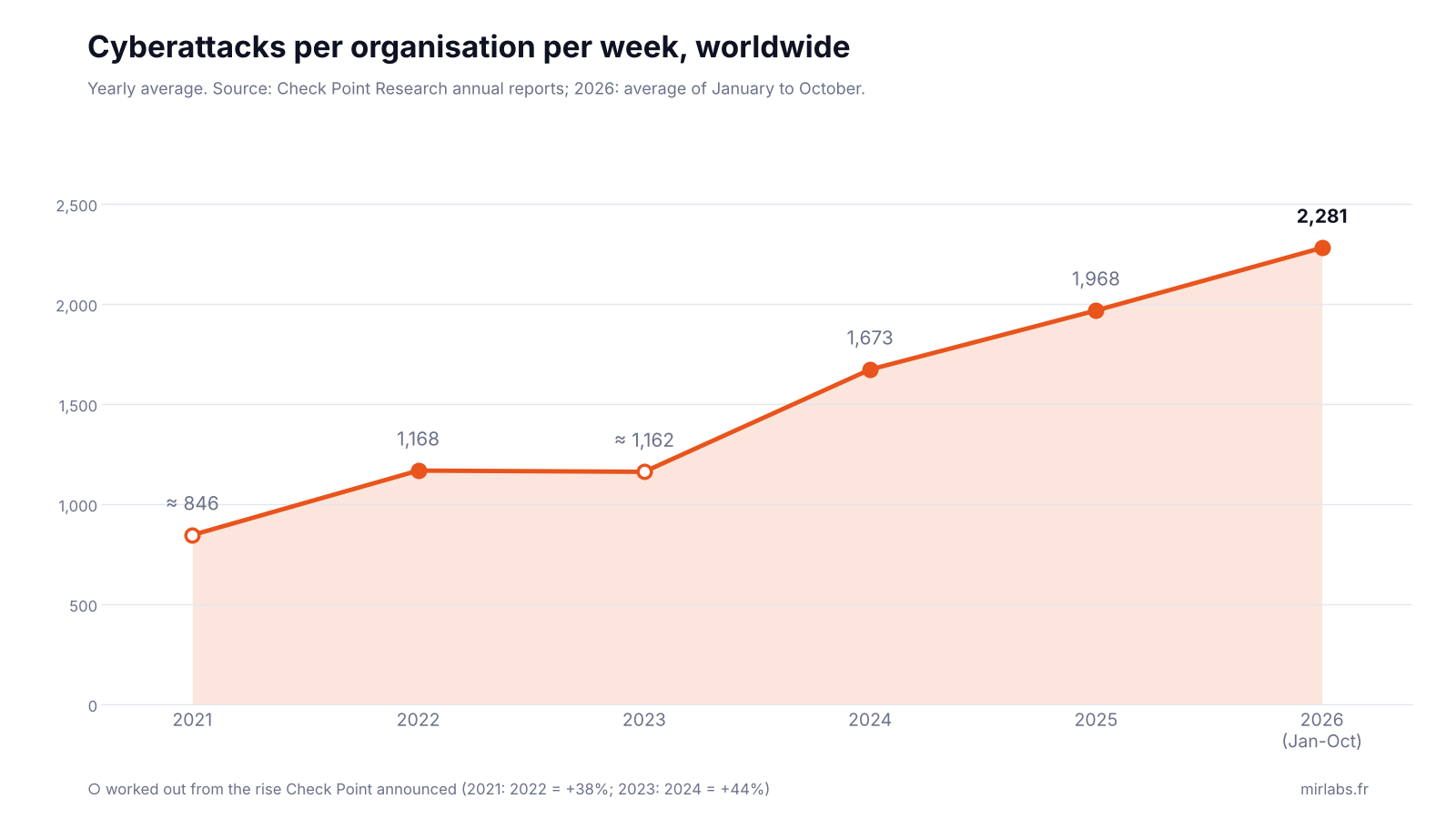
From 2021 to 2026, that is 2.7 times as many. On average about +22% a year, and those rises compound: that is what gives the curves their arrow shape. Two points are worked out rather than published as such (hollow circles): 2021 from the +38% of 2022, 2023 from the +44% of 2024.
Ransomware: up 53% in two years
Ransomware.live counts the companies that ransomware groups list on their leak sites, where they post their victims to put pressure on them. According to the figures quoted by Emsisoft: 5,336 in 2023, 6,129 in 2024, 8,159 in 2025.
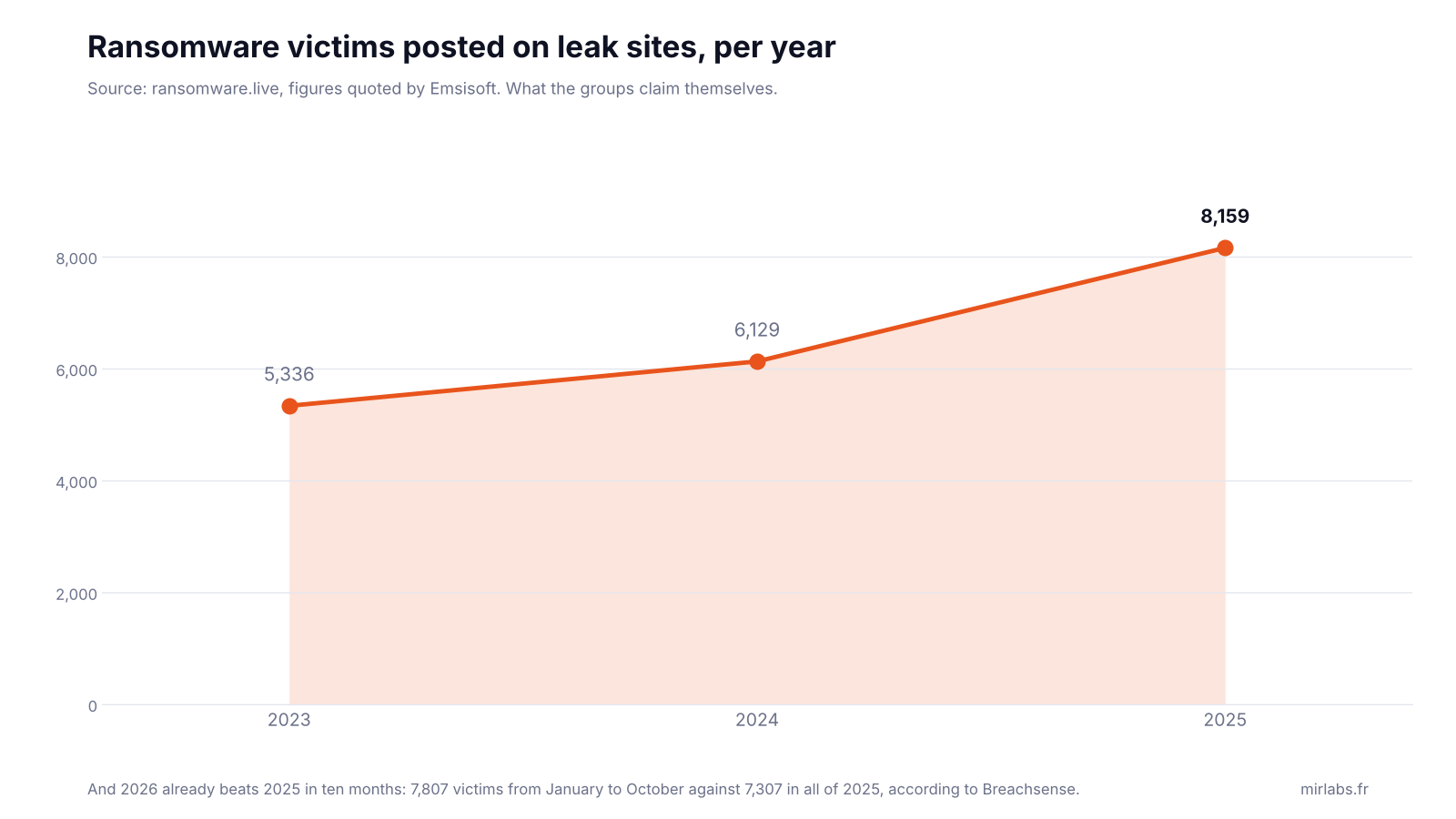
And 2026 is going faster still. According to Breachsense, which counts a little lower than ransomware.live, 7,807 companies were listed from January to October 2026: already more than the whole of 2025 (7,307 at Breachsense).
The last few months, in detail
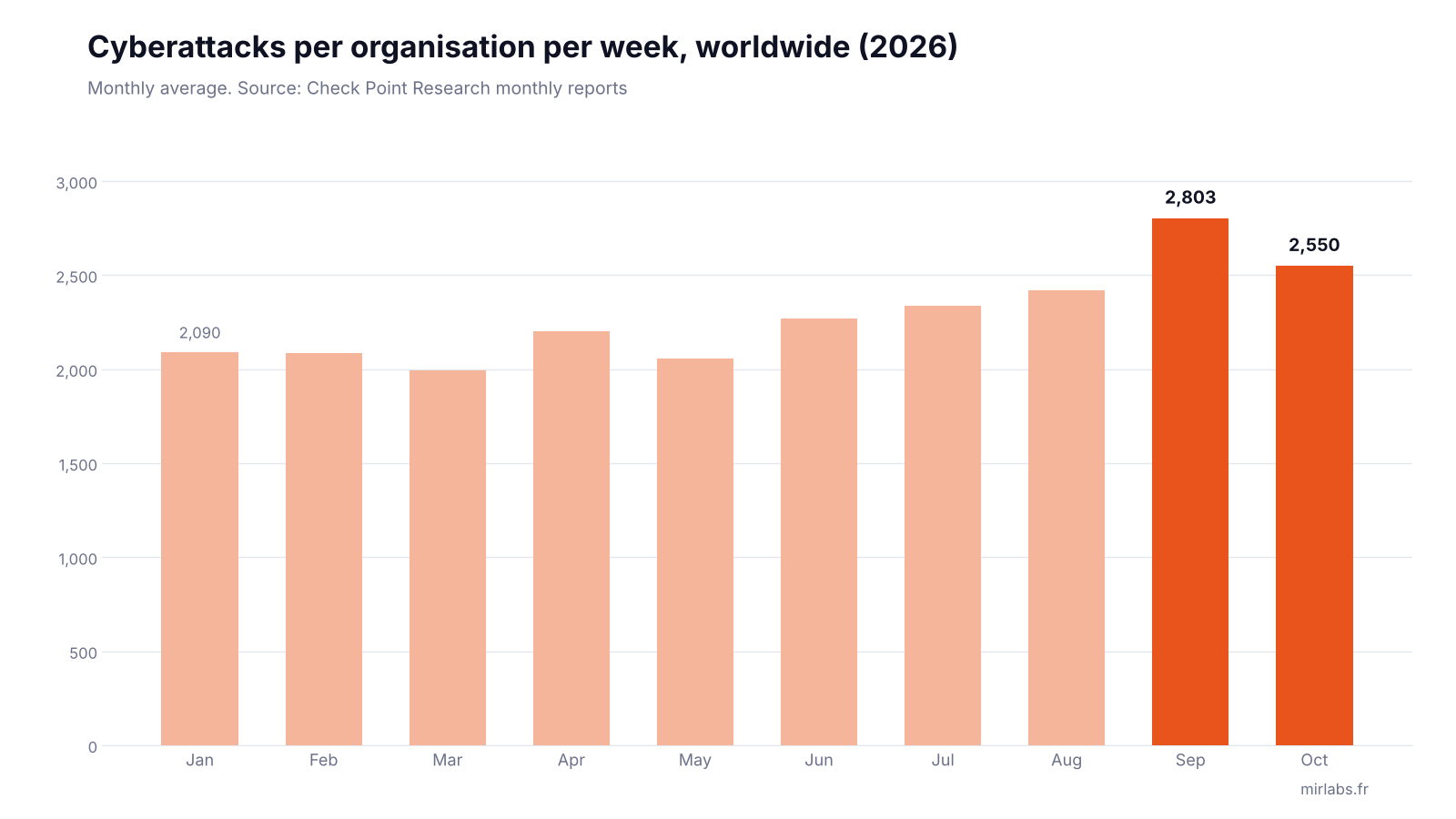
Month by month, 2026 was flat until spring, then the rise resumed: 2,422 attacks per week in August, 2,803 in September (up 48% year on year), 2,550 in October (up 32%).
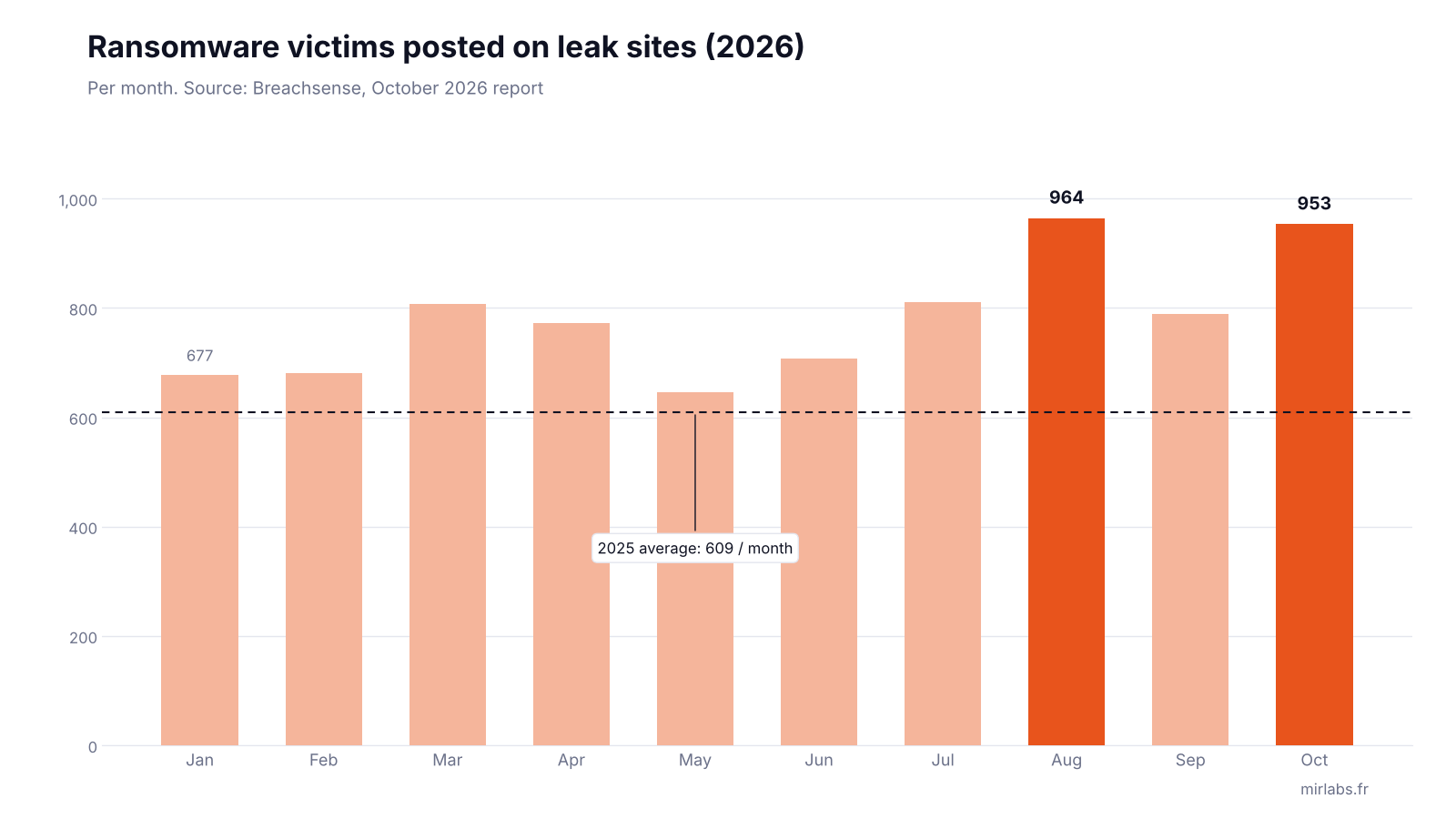
For ransomware, every month of 2026 is above the 2025 average, and August and October come close to 1,000 victims.
What these figures don't say
These curves need careful reading.
- They don't count the same thing. Check Point measures attack attempts seen by its tools. Ransomware.live and Breachsense count victims claimed by the attackers themselves. Other trackers give other totals. The levels differ; the direction is the same.
- A claim is not proof. Some groups pad their lists. Other victims pay quietly and never show up.
- The rise is not steady. 2023 was a pause in the attacks Check Point measures. What matters is the slope over several years.
- These are worldwide figures. France has no equivalent public series. But the big recent cases, and the Prime Minister's words, point the same way.
Why it is rising
The reports give several reasons: more active groups (81 in October according to Breachsense), automated attack tools, and AI speeding up reconnaissance and phishing. In October, Check Point also notes a new ransomware group that relies on AI tooling and went straight into the top three.
The other reason is simpler: companies depend more and more on shared providers. When Orchestra goes down, dozens of brands stop with it, without having been targeted themselves.
The link with AI agents
AI agents are arriving in this landscape. An agent that reads emails, looks up a customer file or refunds an order has access. It becomes a target, like a password or a service account. And it has one more weak spot: you can talk to it. A well-crafted message can push it to show what it shouldn't, or to do what nobody asked.
That is what I test with CrashMire: before going live, we attack the agent the way a fraudster would, and see what it lets through. With curves like these, I think this test will become as normal as a penetration test.
I will update these curves when new reports come out.
Read next

LocService: a cyberattack copied links to rental files
The rental platform LocService, published by Gobocom, says it suffered an intrusion detected on 30 October: names, contact details, invoices and share links to DossierFacile rental files were copied. ID documents and supporting papers were not copied directly.

Ipsos: the Qilin group claims a data theft, ten days after an acknowledged intrusion
Ipsos acknowledged an intrusion into an internal system on 16 November, with no disruption to its business. On 23 November the Qilin group listed it on its site and showed five screenshots of documents. Nothing confirms that these documents come from the acknowledged intrusion.

1Password: a stolen GitHub account was used to copy customer data, without touching the vaults
1Password says an attacker took an employee's GitHub account, slipped malicious code into services and copied customer data: login addresses, identifiers, public keys, some tokens. According to the company, the vaults and master passwords were not reached.